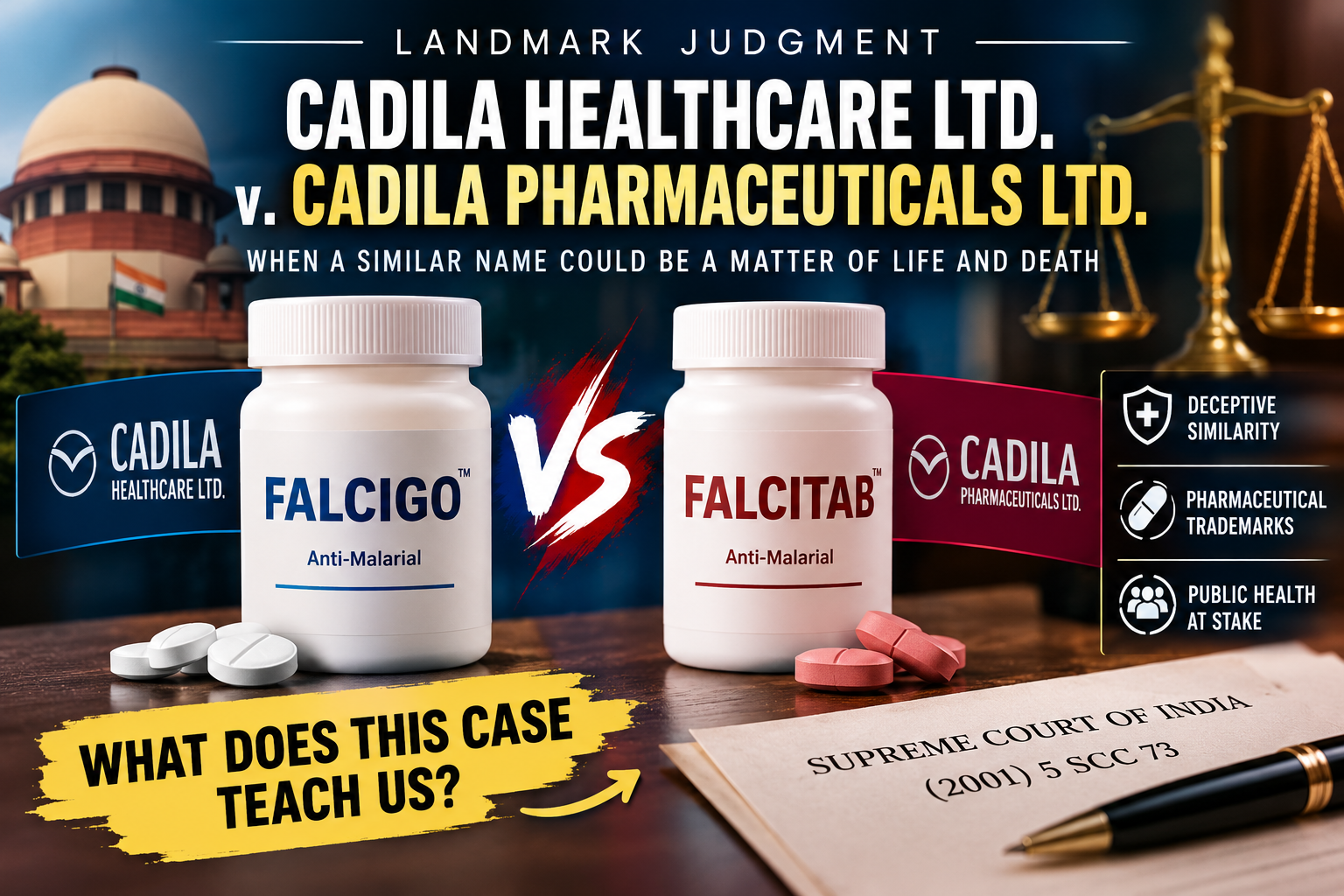
Cadila Healthcare Ltd. v. Cadila Pharmaceuticals Ltd.
Citation: (2001) 5 SCC 73
Court: Supreme Court of India
Date: 26 March 2001
Bench: B.N. Kirpal J., Doraswamy Raju J. and Brijesh Kumar J.
Area of Law: Trademark Law, Passing Off, Deceptive Similarity and Pharmaceutical Trademarks
---
1. Introduction
Cadila Healthcare Ltd. v. Cadila Pharmaceuticals Ltd. is a landmark judgment of the Supreme Court of India concerning the principles of deceptive similarity and passing off in relation to pharmaceutical products.
The case is particularly significant because the Supreme Court recognised that confusion between medicinal products can have consequences far more serious than ordinary commercial confusion.
The judgment therefore established that a stricter approach should be adopted while determining the likelihood of confusion between pharmaceutical trademarks.
---
2. Facts of the Case
Cadila Healthcare Ltd. and Cadila Pharmaceuticals Ltd. were both pharmaceutical companies.
Both companies had emerged from the restructuring of the erstwhile Cadila Group under Sections 391 and 394 of the Companies Act. Under the restructuring scheme, both companies were entitled to use the word "CADILA" as part of their corporate names.
The dispute, however, concerned two different medicinal trademarks.
Cadila Healthcare Ltd. introduced an anti-malarial drug under the trademark "FALCIGO".
The drug contained Artesunate and was used for the treatment of cerebral malaria, commonly associated with Falciparum malaria.
Cadila Healthcare applied for registration of the trademark FALCIGO on 20 August 1996. The Drugs Controller General (India) granted permission to market the drug under the trademark FALCIGO on 7 October 1996.
Cadila Healthcare stated that it began manufacturing and selling FALCIGO throughout India from October 1996.
Subsequently, Cadila Pharmaceuticals obtained permission on 10 April 1997 to manufacture a drug containing Mefloquine Hydrochloride and was also permitted to import the drug.
The respondent marketed this medicine under the trademark "FALCITAB".
Cadila Healthcare came to know in April 1998 that Cadila Pharmaceuticals was selling FALCITAB for the treatment of Falciparum malaria.
Cadila Healthcare alleged that FALCIGO and FALCITAB were deceptively similar and that the use of FALCITAB could result in the respondent's product being passed off as the appellant's product.
---
3. Why Was the Similarity Important?
The dispute was particularly important because both medicines were intended for the treatment of the same disease.
Cadila Healthcare argued that the similarity between the names could cause confusion among doctors, pharmacists, hospitals and consumers.
The appellant also emphasised that the medicines were important drugs and that confusion could potentially have serious consequences.
The respondent, on the other hand, argued that the prefix "Falci" was derived from Falciparum malaria and that pharmaceutical companies commonly use portions of disease names in their trademarks to indicate the purpose of a medicine.
The respondent also argued that both products were Schedule L drugs, which were not sold over the counter but were supplied to hospitals and clinics. According to the respondent, this significantly reduced the possibility of confusion.
---
4. Proceedings Before the Lower Courts
Cadila Healthcare filed a suit before the District Court at Vadodara seeking an injunction restraining Cadila Pharmaceuticals from using the trademark FALCITAB.
The Extra Assistant Judge, Vadodara, rejected the application for interim injunction on 30 May 1998.
The Trial Court observed that the two medicines differed in:
- - Appearance
- - Formulation
- - Price
The Court also considered the fact that the medicines were supplied to hospitals and institutions rather than being sold directly to individual consumers.
On this basis, the Trial Court found insufficient grounds for granting an interim injunction.
Cadila Healthcare appealed to the High Court.
The High Court also declined to interfere and concluded that there was little likelihood of confusion or passing off between the two products.
Cadila Healthcare therefore approached the Supreme Court of India.
---
5. Arguments of Cadila Healthcare Ltd.
Cadila Healthcare essentially argued that:
- FALCIGO and FALCITAB were deceptively similar trademarks.
- The two medicines were used for the same disease, namely Falciparum malaria.
- The similarity in the names could result in confusion among doctors, pharmacists and other persons involved in the supply of medicines.
- The fact that the medicines were supplied on prescription or through hospitals could not completely eliminate the possibility of confusion.
- The consequences of confusing one medicinal product with another could be extremely serious.
- Greater caution should therefore be exercised when assessing deceptive similarity in pharmaceutical trademarks.
---
6. Arguments of Cadila Pharmaceuticals Ltd.
Cadila Pharmaceuticals argued that:
- The word "Falci" was derived from Falciparum malaria.
- It was common in the pharmaceutical industry to use portions of disease names in trademarks to indicate the purpose of a drug.
- The two medicines had different formulations.
- The two products differed in appearance and price.
- Both medicines were Schedule L drugs and were supplied to hospitals and clinics rather than being sold across the counter.
- Because doctors and medical professionals were involved in the supply of the medicines, there was little likelihood of confusion or deception.
---
7. Main Legal Issue
The central question was:
What principles should be applied while determining whether two trademarks are deceptively similar, particularly when the trademarks are used for medicinal products?
The case also required the Court to consider the principles applicable to an action for passing off.
---
8. Passing Off
The Supreme Court explained the basic principle behind passing off.
A person cannot represent his own goods as being the goods of another person.
The Court referred to the traditional elements of passing off, including:
- - Misrepresentation;
- - Made in the course of trade;
- - Directed towards prospective customers or consumers;
- - Likely to cause injury to the goodwill or business of another trader; and
- - Resulting in actual or probable damage.
The Court also recognised that Section 27(2) of the Trade and Merchandise Marks Act, 1958 preserves the remedy of passing off even in relation to an unregistered trademark.
---
9. Deceptive Similarity
The Supreme Court discussed several earlier decisions concerning deceptive similarity.
The Court emphasised that trademarks should generally be considered as a whole.
A court should not conduct an excessively technical or microscopic comparison of individual letters or syllables.
Both visual similarity and phonetic similarity can be relevant.
The Court also referred to the principle that the perspective of a purchaser with average intelligence and imperfect recollection is important.
The overall impression created by the competing marks and the surrounding circumstances must be considered.
---
10. The Special Rule for Pharmaceutical Trademarks
This is the most important part of the judgment.
The Supreme Court held that pharmaceutical trademarks require a stricter approach when assessing the possibility of confusion.
The reason is simple:
Confusion between ordinary consumer products may primarily result in economic or commercial loss.
However, confusion between two medicines can potentially result in serious health consequences or even loss of life.
The Court therefore stated that strict measures should be adopted to prevent confusion between medicinal products, particularly where the medicines are important or potentially life-saving drugs.
The Court further rejected the argument that the fact that a medicine is available only on prescription automatically eliminates the possibility of confusion.
Doctors and pharmacists are trained professionals, but they are still human and can make mistakes.
11. Indian Conditions Must Be Considered
The Supreme Court also emphasised that trademark law cannot be applied without considering the actual conditions prevailing in India.
India has:
- - Linguistic diversity;
- - Urban, semi-urban and rural populations;
- - Different levels of literacy;
- - Consumers who may not understand English;
- - Different levels of medical supervision and infrastructure.
Therefore, the Court held that principles developed in foreign jurisdictions cannot simply be applied mechanically without considering Indian conditions.
A mark that may appear distinguishable to a person familiar with the English language may still sound confusingly similar to another mark to an Indian consumer.
---
12. Factors for Determining Deceptive Similarity
The Supreme Court laid down the following factors to be considered while determining deceptive similarity in an action for passing off:
1. Nature of the marks
The Court should consider whether the competing marks are:
- Word marks;
- Label marks; or
- Composite marks.
2. Degree of resemblance
The Court should examine the degree of resemblance between the marks, including:
- Visual similarity;
- Phonetic similarity; and
- Similarity in idea.
3. Nature of the goods
The nature of the goods for which the competing trademarks are being used must be considered.
4. Similarity in the goods
The Court should consider the nature, character and performance of the competing goods.
5. Class of purchasers
The Court should consider:
- Who purchases the goods;
- Their level of education;
- Their intelligence;
- The degree of care they are likely to exercise.
6. Mode of purchase
The Court should consider how the goods are purchased or ordered.
7. Surrounding circumstances
Any other circumstances relevant to determining whether the competing marks are likely to cause confusion must also be considered.
The Supreme Court clarified that each factor does not necessarily receive equal weight in every case. The importance of each factor depends upon the facts and circumstances of the particular dispute.
---
13. Supreme Court's View on S.M. Dyechem
The Supreme Court also considered its earlier decision in S.M. Dyechem Ltd. v. Cadbury (India) Ltd.
The Court disagreed with the approach in that case to the extent that it gave importance to differences in the essential features of competing marks.
The Supreme Court reaffirmed that, in a passing-off action, the important question is whether there is similarity between the competing marks and a likelihood of deception or confusion.
The Court also reaffirmed the importance of phonetic similarity.
M/S S.M. Dyechem Ltd vs M/S Cadbury (India) Ltd JUDGEMENT
14. Role of the Drugs Regulatory Authorities
The Supreme Court made an important observation regarding the regulatory approval of pharmaceutical trademarks.
The Court referred to Section 17-B of the Drugs and Cosmetics Act, 1940, concerning spurious drugs and imitation or resemblance likely to deceive.
The Court observed that before permitting a drug to be manufactured under a particular brand name, the relevant authority should be satisfied that the use of that name would not create confusion or deception in the market.
The Court suggested that authorities should consider requiring applicants to submit an official Trade Marks Registry search report relating to the proposed trademark.
---
15. Judgment of the Supreme Court
The Supreme Court did not finally decide the merits of the passing-off dispute at that stage.
The Court did not grant a final finding that FALCIGO and FALCITAB were deceptively similar.
Instead, the Court explained that evidence could be required to determine the dispute on its merits.
Therefore, the Supreme Court did not interfere with the orders of the courts below at that stage and directed that the underlying suit be disposed of expeditiously.
At the same time, the Supreme Court laid down important principles that the Trial Court was required to keep in mind while deciding the dispute.
The appeal was ultimately disposed of without an order as to costs.
---
16. Ratio / Legal Principle
The central legal principle emerging from the judgment is:
In pharmaceutical trademark disputes, a stricter approach must be adopted while determining the likelihood of confusion because confusion between medicinal products can have serious consequences for public health.
The Court also established that deceptive similarity should be assessed by considering the marks as a whole and by examining the relevant surrounding circumstances rather than by conducting a purely technical comparison of individual portions of the marks.
---
17. Importance of the Judgment
This judgment has become a leading authority in Indian trademark law, particularly in disputes involving pharmaceutical products.
Its importance can be summarised as follows:
- - It established a stricter standard for pharmaceutical trademarks.
- - It recognised the public-health consequences of confusion between medicines.
- - It reaffirmed the importance of phonetic similarity.
- - It emphasised that trademarks should generally be compared as a whole.
- - It identified important factors for determining deceptive similarity.
- - It emphasised the importance of Indian social and linguistic conditions.
- - It clarified that prescription-only status does not completely eliminate the possibility of confusion.
- - It provided guidance to courts dealing with passing-off actions involving medicinal products.
---
18. Key Lesson for Trademark Practitioners
The Cadila judgment demonstrates that trademark similarity cannot always be examined in isolation.
The same degree of similarity may be treated differently depending upon the nature of the goods and the consequences of confusion.
For pharmaceutical products, the possibility of harm makes the prevention of confusion particularly important.
Therefore, when analysing a pharmaceutical trademark dispute, a practitioner should examine not only the competing names but also:
the goods + consumers + purchasing method + phonetic similarity + visual similarity + nature of the disease + consequences of confusion + surrounding circumstances.
---
19. Conclusion
Cadila Healthcare Ltd. v. Cadila Pharmaceuticals Ltd. remains one of the most important Indian judgments on deceptive similarity in pharmaceutical trademarks.
The judgment moved the focus beyond a simple comparison of two words and required courts to consider the overall circumstances of the dispute, while applying a stricter standard where medicinal products are involved.
The underlying principle is that trademark law must protect not only commercial goodwill but, in appropriate cases, also the health and safety of consumers.
Key Principle:
"A stricter approach should be adopted while determining the possibility of confusion between medicinal products because such confusion may have serious consequences for health and life."
Exact judgement from INDIAN KANOON