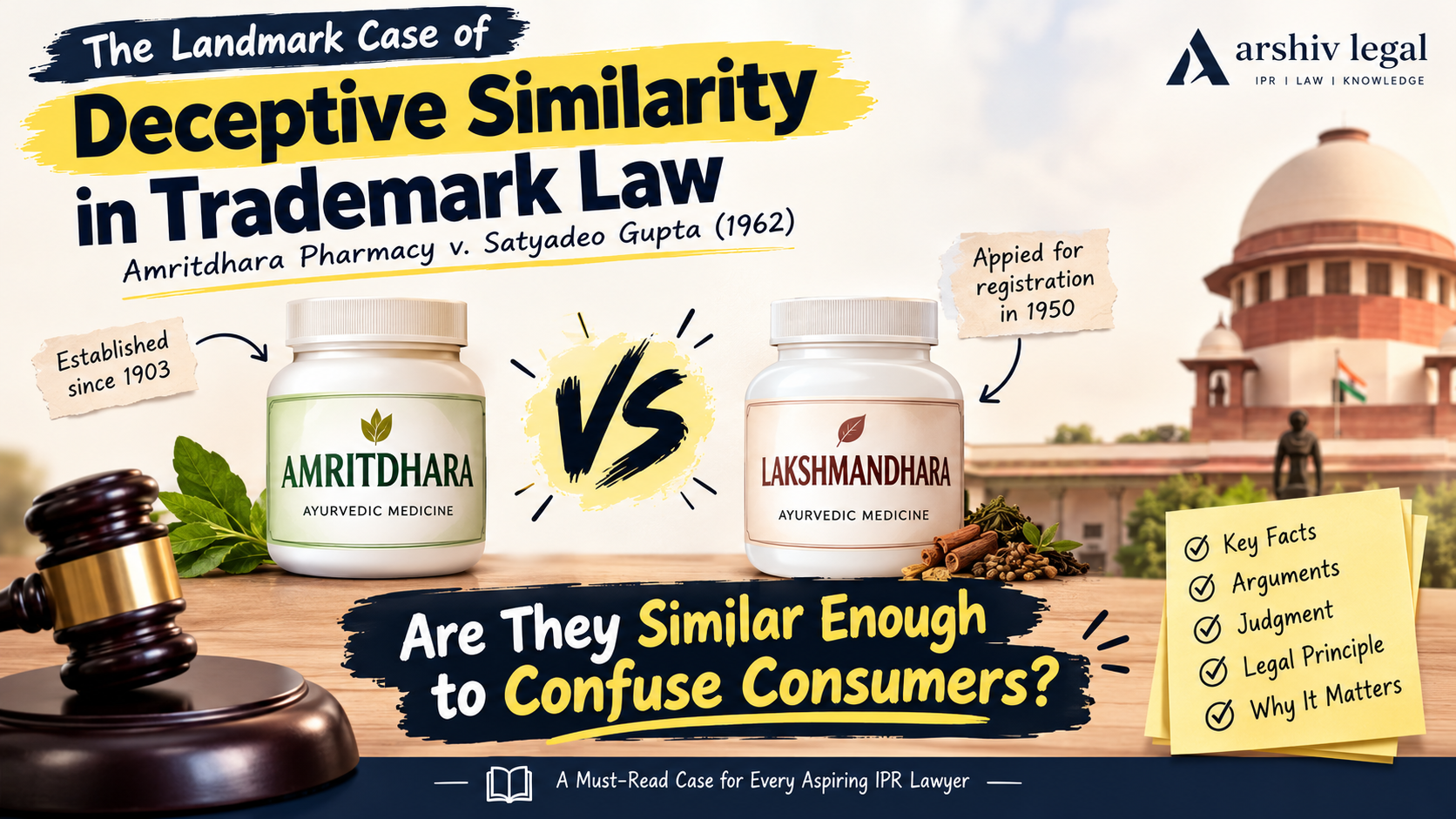
Amritdhara Pharmacy v. Satyadeo Gupta (1962)
A. Facts of the Case
Amritdhara Pharmacy had been selling a medicinal preparation under the trademark “Amritdhara” since 1903. Over time, the mark acquired considerable reputation.
Satyadeo Gupta, who carried on business in Kanpur, used the name “Lakshmandhara” for a similar medicinal preparation from 1923. In 1950, he applied to register this name as a trademark.
Amritdhara Pharmacy opposed the application. It argued that the two names were sufficiently similar to confuse customers purchasing similar medicines.
The Registrar of Trade Marks considered the names likely to cause confusion. However, the Registrar also found that Amritdhara Pharmacy had acquiesced in the use of “Lakshmandhara” over a long period despite circumstances indicating awareness of that use. The Registrar therefore permitted registration, but restricted it to sales within Uttar Pradesh.
The matter eventually reached the Supreme Court.
B. Main Legal Issues
The Supreme Court had to consider two principal questions:
Deceptive similarity: Were “Amritdhara” and “Lakshmandhara” sufficiently similar to deceive or confuse consumers purchasing similar medicinal products?
More about deceptive similarity ( cadila healthcare case )
Acquiescence: Could Amritdhara Pharmacy’s conduct justify allowing registration of the similar mark in special circumstances, subject to appropriate limitations?
C. Arguments of the Parties
Amritdhara Pharmacy
Amritdhara Pharmacy argued that:
It had used “Amritdhara” since 1903 and had built a substantial reputation under that name.
Both parties sold similar medicinal products.
The names were sufficiently similar to mislead consumers or cause confusion.
“Lakshmandhara” should not be registered because of this likelihood of confusion.
Satyadeo Gupta
Satyadeo Gupta argued that:
“Amritdhara” and “Lakshmandhara” were different names with different meanings.
He had used “Lakshmandhara” since 1923.
Amritdhara Pharmacy had not raised an effective objection for a considerable period, despite circumstances indicating awareness of his use.
The long-standing use and the circumstances of the case supported allowing registration.
These arguments raised both the question of similarity and the legal effect of acquiescence.
D. Judgment of the Supreme Court
The Supreme Court allowed Amritdhara Pharmacy’s appeal and set aside the High Court’s judgment. However, it restored the Registrar’s original order, including the restriction permitting sales within Uttar Pradesh only.
The Court held that the two names, when considered in relation to similar medicinal goods, were likely to cause deception or confusion.
It explained that the marks must be compared as a whole, rather than by separating their component words and examining each word independently.
The Court also emphasised that trademark similarity should be assessed from the perspective of an ordinary person of average intelligence and imperfect recollection. Consumers do not necessarily remember every detail of a brand name perfectly when making a purchase.
Nevertheless, the Court agreed with the Registrar that the circumstances established acquiescence by Amritdhara Pharmacy. This justified permitting registration subject to the geographical restriction.
Important clarification: The Court did not hold that the marks were dissimilar. It found a likelihood of confusion but upheld the limited registration because of the particular circumstances, including acquiescence.
E. Ratio Decidendi — Legal Principle
The central legal principle of this case is:
To determine deceptive similarity, trademarks must be compared as a whole, considering the perspective of an ordinary consumer with average intelligence and imperfect recollection, along with the circumstances of the case.
The decision also demonstrates that acquiescence may be relevant when deciding whether a similar mark can be registered in special circumstances and subject to appropriate limitations.
F. Relevant Legal Provisions
The case was decided under the Trade Marks Act, 1940, particularly:
Section 8: Concerned with refusal of registration where a mark was likely to deceive or cause confusion.
Section 10(2): Allowed registration in special circumstances, including qualifying cases involving similar marks, subject to conditions or limitations.
For students studying the current Trade Marks Act, 1999, Sections 11 and 12 are useful provisions to read alongside this judgment. Section 11 deals with relative grounds for refusal, including likelihood of confusion, while Section 12 addresses honest concurrent use and other special circumstances.
These provisions of the 1999 Act should not be treated as exact equivalents of the provisions applied by the Court in 1962.
G. Practical Takeaway for Businesses
Suppose a company sells a medicine under the brand name “CoolDrop”. Another business begins selling a similar medicine under the name “CoolDrip.”
Even though the spellings are not identical, a trademark dispute could arise because the names sound similar and are used for similar goods.
A proper assessment would consider the overall appearance and sound of the marks, the nature of the goods, the relevant consumers, and the circumstances in which the products are purchased.
Businesses should therefore conduct a trademark search and seek legal advice before adopting a name similar to an existing mark. They should also act promptly when they discover potentially infringing use; delay and acquiescence can become relevant, depending on the facts and applicable law.
H. Why Is This Case Important?
Amritdhara Pharmacy v. Satyadeo Gupta remains an important Indian trademark judgment because it explains the practical approach to deceptive similarity.
Its enduring lessons are:
- Compare trademarks as a whole.
- Consider the ordinary consumer’s imperfect recollection.
- Assess similarity in the context of the goods or services involved.
- Remember that acquiescence and the surrounding circumstances may affect the final outcome.
In one sentence: A trademark can be confusingly similar to an existing mark even when the names are not identical, but the final legal outcome depends on the applicable law and the circumstances of the case.
READ THE FULL JUDGEMENT AT INDIAN KANOON
Disclaimer: This case study is intended for educational purposes only and is not legal advice. The statutory provisions discussed in the judgment are those of the Trade Marks Act, 1940; readers should consult the current law when addressing present-day trademark disputes.